
Author: Andrew Wells
April 19, 2026
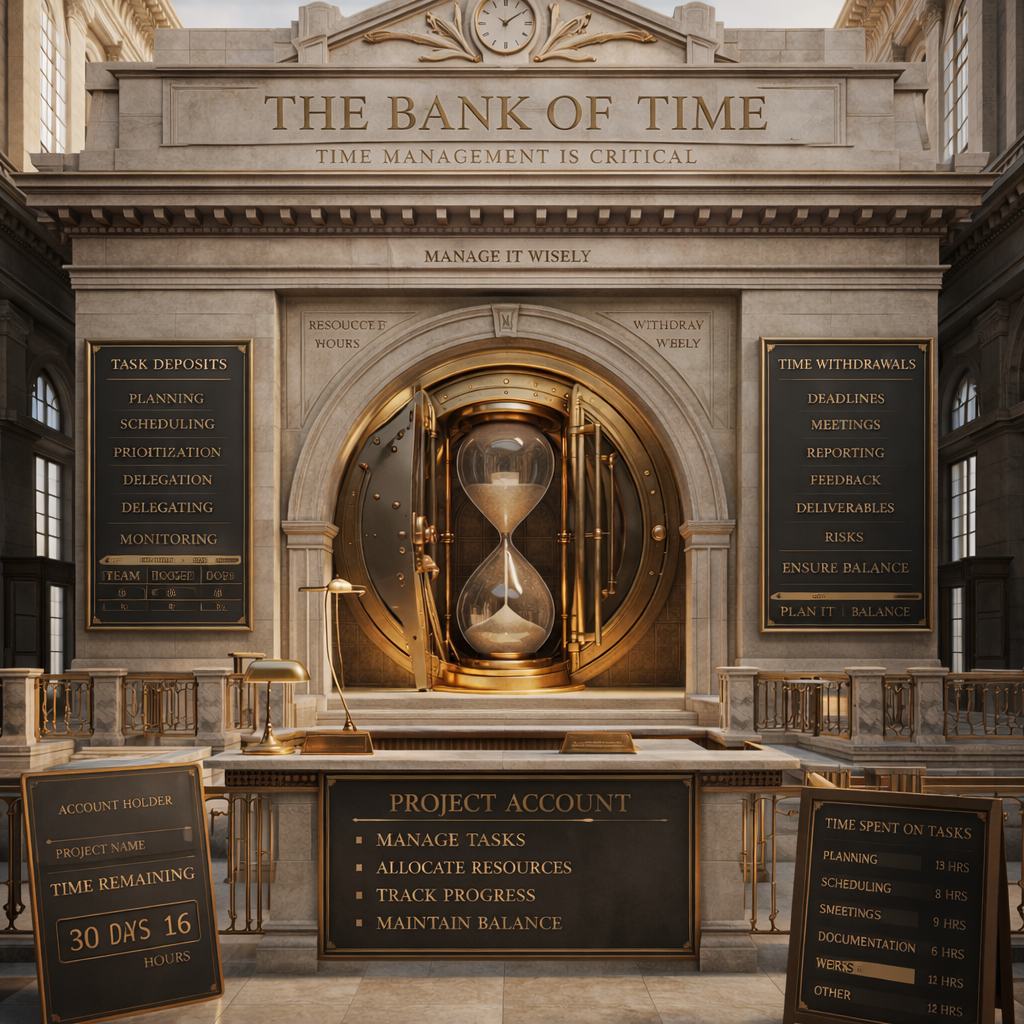
Time in construction management is important for a wide variety of reasons. Both the homeowners’ and contractors’ time is to be considered. Some parts of a project’s duration can affect overhead in a company, valuable time at home for homeowners, and many other variables. When considering a project, time should be managed as closely as the financial budget. The saying “time is money” is a common phrase and can be applied to a project not in a literal sense, but as an analogy.
What is an activity? “A distinct, scheduled portion of work performed during the course of a project.” (PMI, 2026, p. 1).
A project has many moving parts, many of which affect time. Subcontractors, suppliers, project managers, employees, and homeowners all have an influence on time. Each activity within a project has an assigned player and duration. In this analogy, activities are the expense items, players are the currency, and time is the amount. For example, one activity may be to order a cabinet. Depending on the project delivery method, a project manager may be the player responsible for acquiring the cabinet. The project manager, the currency, has a balance, time. If the project manager’s balance (time) is low, it is possible that when it comes time to cash the activity expense check, there will be insufficient funds available.
Other parts of this analogy may include subcontractors and employees that may be unstable, similar to an unstable operating account. Funds fluctuate and may not always be available, or may be more available from time to time. Identification and a mitigation plan for these potentially unstable players will make for a successful project. Identifying and mitigating risk is a basic core principle of project management.
What is risk mitigation? “A risk response strategy that involves decreasing the probability of occurrence or impact of a threat.” (PMI, 2026, p. 26).
Risk is always a factor to consider when planning and managing a project. Risk mitigation is vital for a successful project. Viewing time as money, and managing players on a project as such, building in reserves or a contingency in the form of backup players, available to “fund time accounts,” is one method.
Overall, viewing time as money on a project can be applied to all players and activities. Applying a basic “time is money” approach can help manage time on a project.
After feeding the above paragraphs to ChatGPT, and asking for a full list comparison based on this concept, these were the results:
- Cash = immediately available time
- Bank account balance = current available time capacity
- Income = gained time or recovered schedule capacity
- Expense = time spent
- Cost of goods sold = time directly consumed by project activities
- Overhead expense = indirect time spent on coordination, communication, meetings, and administration
- Profit = time saved versus planned duration
- Loss = time overrun
- Budget = planned time allocation
- Actuals = actual time used
- Variance = difference between planned time and actual time
- Accounts payable = time obligations owed soon to pending activities
- Accounts receivable = time expected back from approvals, responses, or outside actions not yet received
- Accrued expense = time already lost but not yet visible in the schedule
- Prepaid expense = time invested now to reduce future schedule impact
- Depreciation = gradual loss of productive time capacity due to fatigue, burnout, inefficiency, or wear on systems
- Amortization = spreading the time benefit of planning, training, or setup over multiple future activities
- Retained earnings = accumulated schedule advantage from good planning and past efficiencies
- Equity = net schedule strength or overall time position of the project
- Liability = future time commitments the project must still satisfy
- Asset = anything that increases schedule capacity or protects time
- Current assets = time resources available in the near term
- Fixed assets = long-term systems, workflows, or team strengths that consistently improve time performance
- Working capital = short-term usable time capacity available to keep work moving
- Liquidity = how quickly time can be redirected to an urgent activity
- Insolvency = not enough available time to meet current activity demands
- Cash flow = movement of time availability across the life of the project
- Positive cash flow = gaining time faster than losing it
- Negative cash flow = losing time faster than recovering it
- Reserve account = float, contingency, or buffer time
- Emergency fund = management reserve for major delays or unknowns
- Withdrawal = consuming available time for an activity
- Deposit = creating new available time through efficiency, delegation, prefabrication, or early decisions
- Transfer = moving time capacity from one activity, crew, or phase to another
- Transaction fee = inefficiency, interruptions, handoff loss, or extra coordination time
- Interest earned = compounding schedule benefit from early good decisions
- Interest paid = compounding schedule damage from delays, rework, and late decisions
- Penalty = time loss caused by missed deadlines or late actions
- Bad debt = time invested that cannot be recovered
- Write-off = accepting lost time as unrecoverable
- Write-down = reducing expectations for available time from a resource or phase
- Audit = schedule review, progress review, or time performance analysis
- Internal controls = processes that protect project time from waste or misuse
- Fraud = false reporting of progress, availability, or productivity
- Misallocation of funds = assigning time to low-priority work while critical activities wait
- Forecast = projected completion based on current time performance
- Budget revision = schedule update or re-baseline
- Capital investment = spending time now on planning, systems, or training to save more time later
- Diversification = spreading time risk across multiple resources, suppliers, or work paths
- High-risk investment = unreliable subcontractor, unstable labor, or uncertain supplier lead time
- Stable investment = dependable resource with predictable time availability
- Market volatility = fluctuating labor availability, procurement uncertainty, weather, or owner changes
- Frozen assets = time capacity that exists on paper but cannot currently be used
- Illiquid asset = highly skilled resource that is valuable but not available when needed
- Opportunity cost = time lost by choosing one activity instead of another more critical one
- Break-even point = the point where recovered or saved time equals time lost
- Return on investment = time saved from a planning decision compared to the time spent making it
- Ledger = project schedule or time tracking system
- Journal entry = recorded update to time usage, delay, progress, or reassignment
- Chart of accounts = work breakdown structure or categorized schedule activities
- Line item = individual task or activity
- Account classification = grouping time by phase, trade, responsibility, or cause
- Reconciliation = comparing planned schedule to actual field conditions
- Closing the books = finishing a phase and locking in actual time performance
- Fiscal discipline = disciplined time management
- Bankruptcy = complete schedule collapse with no realistic recovery under current resources
A few especially strong ones for your concept are:
- Time liquidity = how available usable time really is
- Time insolvency = when responsibilities exceed available time
- Time reserves = float and contingency
- Time investment risk = uncertainty in subcontractor or supplier reliability
- Compounding interest = delays creating more delays downstream
This article was written using ChatGPT for research, in addition:
PMI. (2026). PMI Lexicon of Project Management Terms Version 5.0. https://www.pmi.org/-/media/pmi/documents/registered/pdf/pmbok-standards/pmi-lexicon-pm-terms.pdf?rev=447328d841c249af985d14177ddd5f95.
Leave a Reply